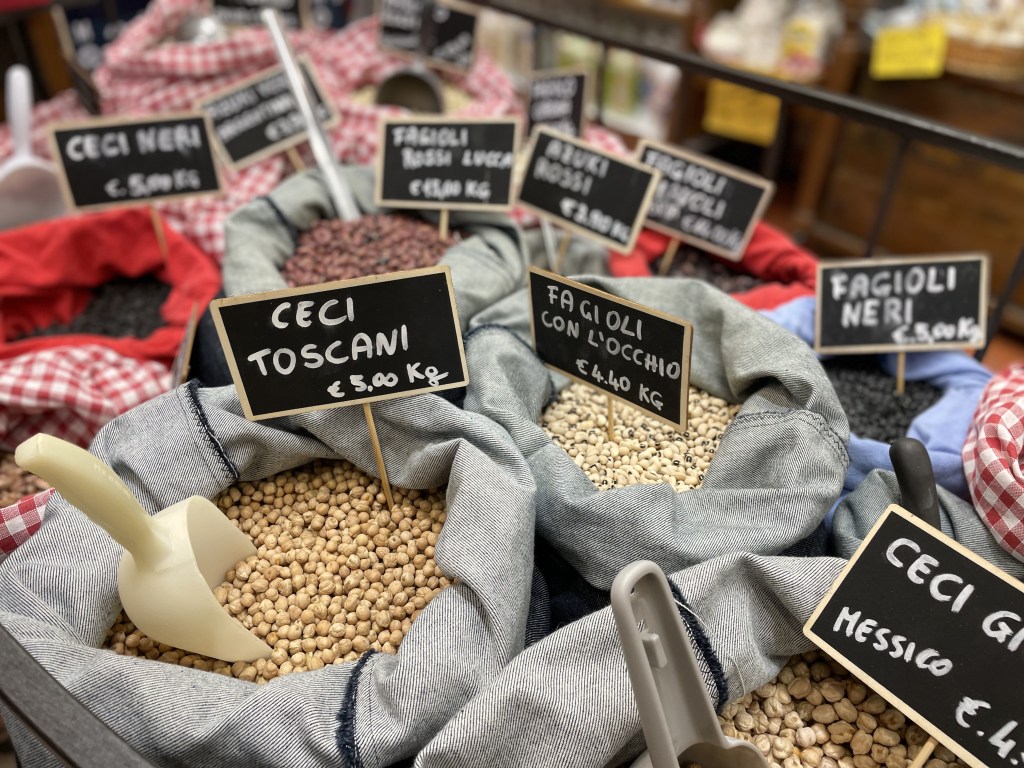
One observation I have made since living in Florence are the pronounced regional attachments and differentiations that seem to undergird Italians’ culinary identities. This complex regionalism is informed by geography but also a set of cultural markers. Tuscan cuisine, as you would expect, is very different to the cuisines in Sardegna, Apulia, and Sicily. But even with cities and areas nearby, locals make quite strong distinctions. Bologna is only 40 minutes from Florence by train, yet, it seems to be a completely different culinary world. In Bologna, Tortellini float peacefully through creamy sauces or swim in clear, flavourful broths. In Florence, in contrast, you have to dig through the rich and dense vegetable soup with bread called Ribollita. Why are these culinary regionalisms so pronounced? Why do they seem so important to many Italian people? I am motivated to explore the complex kaleidoscope of Italian cuisines further. I am also committed to challenging perceived ‘national cuisines’ by employing a transnational perspective.
National narratives still inform a large part of culinary public knowledge. Frequently, I encounter cooking books on, e.g., Italian cooking, Japanese cooking, or French cooking. Other cooking book concepts may zoom into a particular area or focus on specific techniques, products, or lifestyle choices. As a historian, I am drawn to transnational approaches that challenge the presumption of cultural curtailing by borders. In the last thirty years, we have seen historiographical movements that focus on non-state interaction and exchange between actors, organisations, or companies across borders. Professor Jan Rüger, for instance, wrote an insightful article in 2004 on transnational approaches for modern European history. It is called “OXO: Or, the Challenges of Transnational History” and focuses on the meat essence OXO and its history of Anglo-German entanglement. Trade of produce is a key topic in transnational economic history. I believe a transnational exploration of recipes and food preparation could also be fruitfully integrated into cooking books and culinary journalism.
In addition to transnational history, the history of internationalism has grown steadily as an academic field. International historians usually inquire into nation states’ relation to the emergence of international organisations in the 19th and 20th centuries. Think of the League of Nations, the United Nations, and the World Food Programme. Researchers frequently focus on the workings of these international organisations, their internal hierarchies and power plays, and their reception by citizens at home. My former supervisor, Professor Patricia Clavin, is a leading international historian. She has produced pioneering work on the League of Nations and is currently working on the history of food systems. To think of these broader historiographical questions and apply their premises and goals to the world of cooking is promising. What scales and perspectives do we choose to frame people’s habits of preparation and consumption? What categorisations, hierarchies, and interpretations do we impose on culinary patterns?
Trained in modern European history, I am particularly fascinated by the question; what is European cuisine? Does such a thing even exist? At a first glance, it seems presumptuous to work with an exclusively European category. I have just laid out my observation of the many cuisines present even within one nation state and the many transnational aspects that inform so-perceived ‘national’ cooking styles. However, I look particularly to the European Union when I ask this question. A union of 27 geographically, economically, and culturally diverse nation-states, and many more equally diverse regions, the EU’s culinary entanglements are more pronounced than you might imagine. The EU’s member-states are bound by many international compromises and transnational connections, including legislation on food quality and hygiene standards.
EU legislation to preserve food standards covers parameters of production, processing, and distribution. At the School of Culinary Arts “Cordon Bleu”, I first learned about the EU framework that guides the preparation and selling of food by “food business operators”. One of the legislations adopted in 2004 is The Hazard Analysis and Critical Control Points principles (HACCP), originally developed in the United States in the 1960s. HACCP guides food business operators, for instance, restaurant owners, to secure safety along the food production chain. It lays out a framework to anticipate all possible dangers to food hygiene and pro-actively resolve and monitor these identified risks. In 2002, the European Food Safety Authority (EFSA) was founded to produce scientific advice on food-related risks to producers and consumers. I find it fascinating to think that the EU somehow connects all people working for the food sector and that all restaurants in the EU (ideally) are guided by a European spirit of high food quality.
Indeed, you can argue that focusing on food standards legislation is a very peculiar approach to make a case for a European cuisine. I am a fervent supporter of the European Union, in awe of its achievements, and committed to resolving its many failures. Therefore, I find it comforting (or at least entertaining) to think that whenever I eat, I have the EU ‘on my plate’. In any case, I believe that synthetic, interdisciplinary thinking can fuel a more conscious and creative engagement with the narratives we choose to formulate on the topic of food. Regionalism, nationalism, Europeanism, and globalism (think of global food chains)—all these perspectives are insightful lenses to shed light on the diverse range of culinary (dis-)connections.

Let’s focus once again on the interplay of Italian cuisine and culinary regionalisms. What do these concepts tell us about cultural habitus? And what even is a cuisine? While it seems like a concept easily comprehensible, it is indeed quite tricky to define its key markers. Does a specific cuisine rely on certain ingredients? Is it inherently enshrined with recipes and preparation ideas? Or is it a set of ideas? I made the case for a European (EU) cuisine based on legislative ideas. While it might seem unintuitive, this approach is certainly more realistic than identifying a shared set of recipes or ingredients. In regard to Italian cuisine, however, I remain puzzled.
This article cannot fully answer all the questions it brought up. I believe this is a longer quest that demands carefully analysed case studies and broad reading. Hopefully, you will join me on this culinary-historical voyage and look forward to reading future reflections on the topic. What do you think makes a regional, national, or european cuisine? Let me know in the comments!
Thank you for reading! Alla prossima! 🙂

 lilly's menu
Liebste Lilly,
I thoroughly enjoyed reading your article (once more) … yes, even at 6am to slowly (no, very quickly actually due to the questions you posed 🙂 ) get my brain functioning in the morning.
You’ve sparked a thought in my head that goes: Through the transmission of different parts of different cuisines (sometimes only certain ingredients), by sharing certain recipes/dishes, brought to regions in the wider sense by travelers and (im)migrants, we all are more intertwined than we actively notice, sometimes – A view point which might get judged as rather romantic by some.. But what’s it all worth without a little hope and an eye for the beauty of being a Union ?! 🙂
Your article also made me think of the fact that the art of preparing certain dishes often gets transmitted through mouth-to-mouth communication (as far as I’m concerned) …and that again made me think of a project I had once heard of and just now rediscovered: The beautiful (and important, in my opinion) YouTube-Channel “Pasta Grannies”. Have a look! I bet you’ll enjoy it and maybe find something useful for your blog as well 🙂
xx, Anna
LikeLike